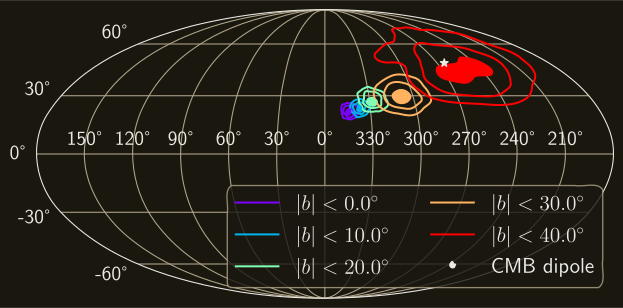
$ head research.md
Research
The central assumptions in cosmology have not changed in the last 100 years. Chief among these is the idea that the Universe is homogeneous and isotropic. This means we should see the same Universe in every direction no matter where we are (the cosmological principle).
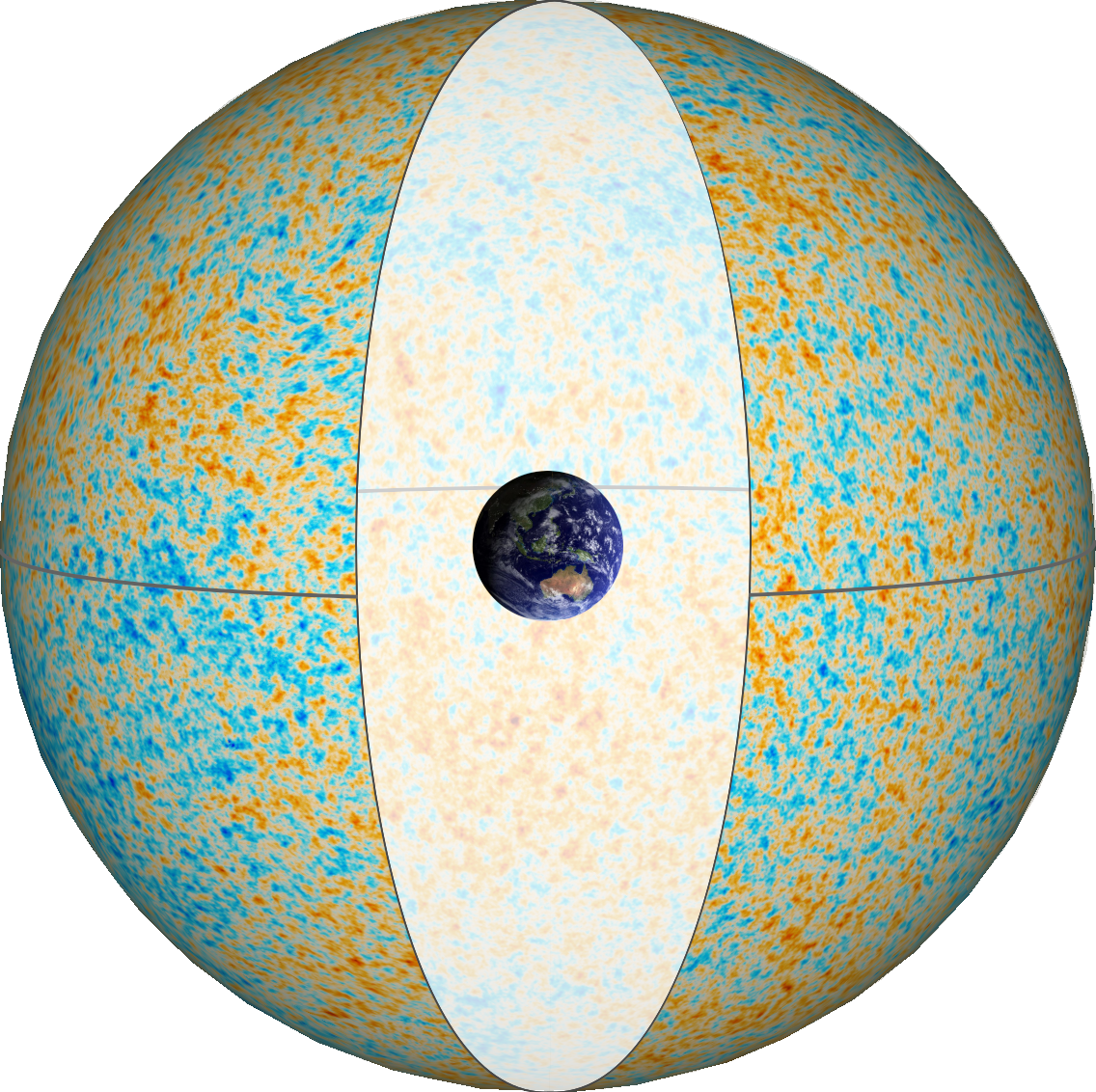
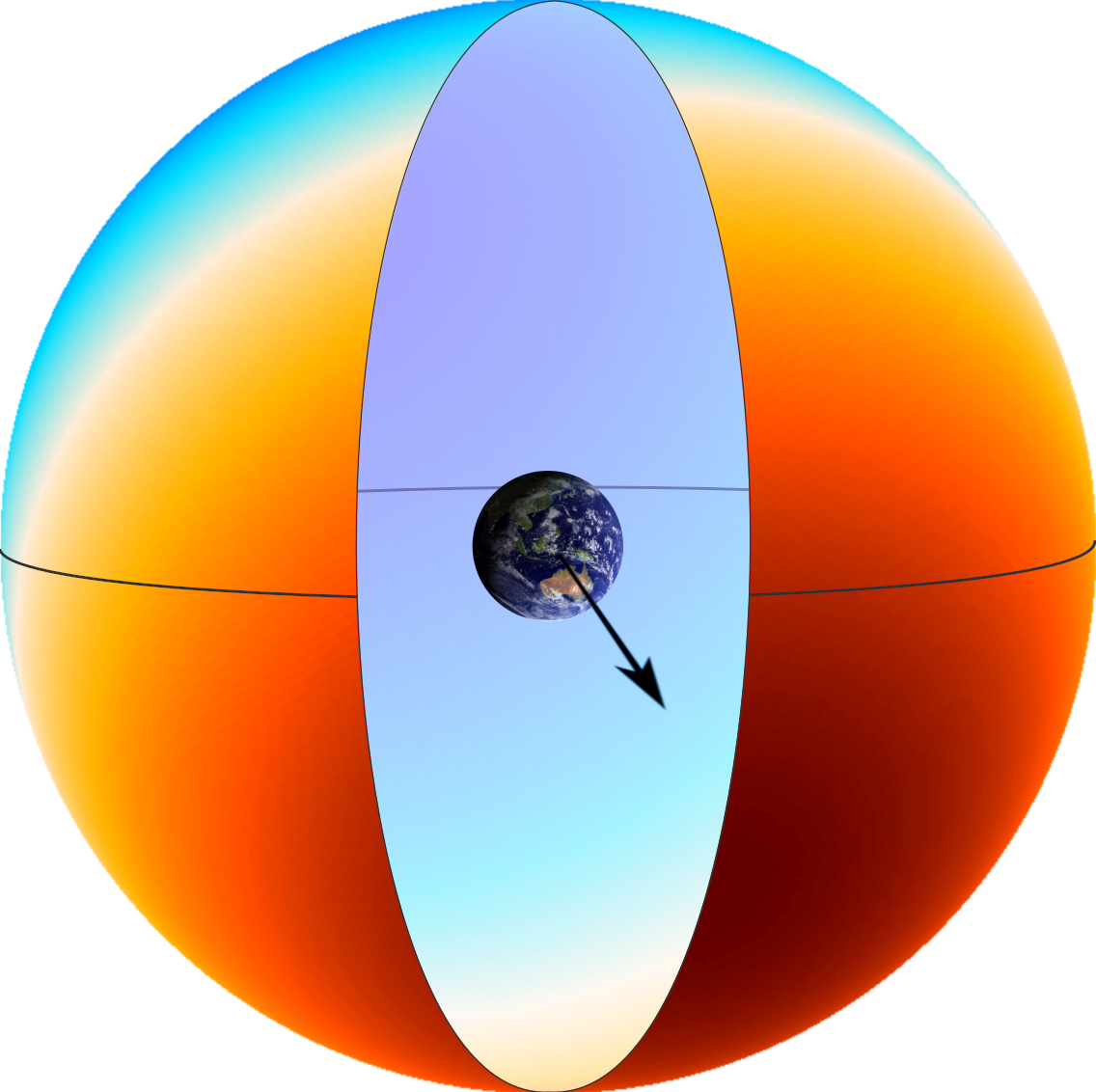
The best evidence for this assumption comes from the cosmic microwave background, which appears as a statistically isotropic and homogeneous field of temperature fluctuations (top right). But we only see this after subtracting a dipole from the temperature map (bottom right). This dipole is thought to arise from our motion through the Universe with respect to the CMB.
According to special relativity, our motion causes galaxies in front of us to appear brighter and behind us to appear fainter. We should be able to measure this dipole in flux-limited galaxy surveys and check if it matches the CMB dipole. If it does, we are right in assuming that the CMB defines a rest frame in which the Universe is homogeneous and isotropic. If not, then something could be suspect in our basic understanding of the Universe.
$ grep -i "focus area" research.md
Current Focus
My work tackles the statistical language used to measure this dipole in galaxy surveys, which is termed the cosmic dipole. I am developing a coherent framework to quantify our state of knowledge in light of imperfect data. This includes accounting for systematic effects, incomplete sky coverage and theoretical concerns.
This is of great interest in the face of growing evidence that the cosmic dipole is inconsistent with the CMB dipole (arXiv:2505.23526). If genuine, this represents a serious challenge to our understanding of the Universe. Thus, methodological rigour is critical.
$ grep -i highlights research.md
Research Highlights
Simulation-based inference
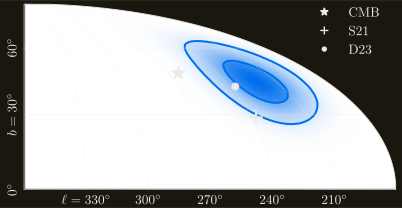
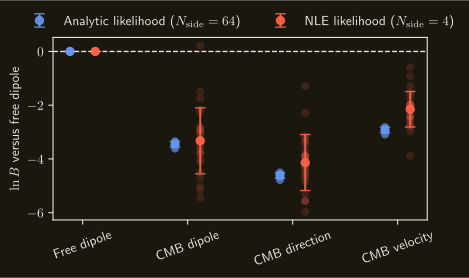
In arXiv:2602.05070 we apply simulation-based inference to measure the cosmic dipole for the first time. This gives a principled way to deal with difficult systematic issues that obscure an obvious choice of likelihood function. Instead of specifying one analytically, it is learned from simulations. Thus we can carry out a maximally Bayesian analysis, inferring cosmology and systematics simultaneously. The posterior distribution for the dipole direction is shown in the figure below.
Since we learned the likelihood function, we can also learn the Bayesian evidence and compute Bayes factors! See this in action below. The uncertainties are larger than the analytic (true) reference values, but this is very promising for complex datasets where likelihoods will be elusive. These next-generation surveys, each with complex data-reduction pipelines, will have their own instrumental effects. Thus, forward-modelling with SBI will be essential. I am actively investigating how this approach can be used in current-generation radio data and forecasting what will change in the future.
Bayesian dipoles
When we can write down likelihood functions, classic Bayesian statistics offers a unified framework for inference. We show this across optical and radio datasets in arXiv:2311.14938 and arXiv:2406.01871, and illustrate how it can be extended to incorporate higher-order multipoles in arXiv:2412.12600.